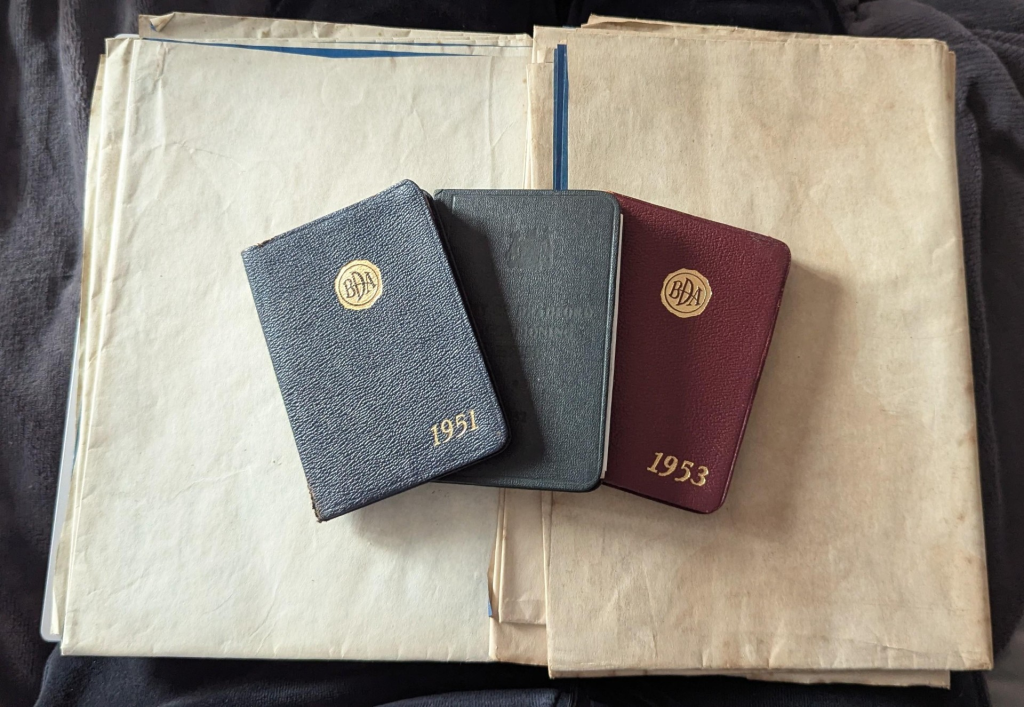
On my desk today is a small stack of mid‑century booklets: BDA editions from 1951 and 1953, and a 1952 handbook from the City of Bradford Conditioning House. They’re modest objects, textured covers, gold lettering on two, the kind of thing that would once have been slipped into the coat pocket of a clerk, tester, or merchant or kept in the top drawer of a mill office. But together they hold a quiet record of how the textile world organised itself, measured itself, and kept its working rhythms in order.
The Bradford Conditioning House played a central role in the wool industry. It was the place where cloth was tested, weighed, and certified, ensuring that moisture content, weight, and quality were standardised and fair. The BDA booklets sit alongside this system, part of the same network of rules, expectations, and industrial knowledge that shaped everyday working life.
These booklets weren’t designed to be precious. They were working tools: reference points for clerks, testers, merchants, and the many women whose labour kept the mills moving. They’re small, but they speak to the larger machinery of industry, the paperwork behind the production, the quiet bureaucracy that made everything else possible.
What draws me to them is their ordinariness and their textured covers. They’re not grand documents or museum pieces. They’re the kind of objects that survive almost by accident, carrying with them the texture of a world built on precision, repetition, and care. A few slim volumes, spanning just a handful of years, and suddenly a whole working world comes back into view.
Objects like these remind me that history often lives in the smallest forms. A stack of booklets, a set of dates, a trace of someone’s working day, and the past becomes tangible again.
Leave a Reply